Heat Acclimation Takes Months, Not Weeks
Every time an athlete falls apart in a hot event, the comment section solves it in about four minutes. Ryne Sullivan read those comments after this summer and brought them to the episode.
"The amount of people who are like, doesn't Alexis own a sauna, it's not that hard to get heat acclimated."
It is that hard.
That kicked off most of episode 6. We spent it on the environment: what heat actually does to an athlete, how long adaptation really takes, and why the athlete training in a garage with a fan is not ready for a competition floor that is twenty degrees cooler and far less humid. We also got into sweat loss, two very different sleep routines, and the order recovery work belongs in.
What Alexis actually did
I will not give away all of it, but I will happily correct the record on the timeline.
"There was no stone left unturned. For months. Not six weeks. We are talking five to six months."
That was consistent sauna work, well past the basic acclimation recommendations, plus pre-cooling before events and cooling methods during them. And there is still a ceiling on it, because heat tolerance has a physiological set point and everybody's is different.
Ryne made that point with Mia, who grew up in Florida while he grew up in South Louisiana, both playing outdoor sports in the same kind of summer. "There was no reason aside from genetic presets why her heat tolerance would be so much better than mine." She runs a 10K in the middle of the day in the sun and barely loses anything. He used to fall apart at 75 degrees.
Some of it is structural. Body size matters. So does limb length, because limbs get more air exposure per unit of mass than a long thick torso does. Ryne pointed at marathoner Paula Radcliffe, who almost never lost below a certain temperature and almost never finished top five above it.
The environment your athlete trains in is lying to them
Ryne's athlete Taylor trained in a garage in south Louisiana with the air on, where the humidity sits near 100 percent year round. Then he would get to a competition floor twenty degrees cooler and far drier, and say it felt like he was breathing daggers into his lungs.
That is the gap, and it exists because we absorb heat in more than one way. Ambient temperature matters. Humidity matters, because evaporation is how we shed heat and high humidity shuts it down. Then there is radiant heat, the sun beating directly on an athlete. Training outside in the sun loads far more heat than training in a hot gym with the bay doors open.
The fan is the real problem. Put an athlete in a hot gym with a fan on them and they will sweat heavily, but touch their skin at the midline or the forearms and it can be cold. That mechanism works, but only when temperature, humidity, and airflow cooperate.
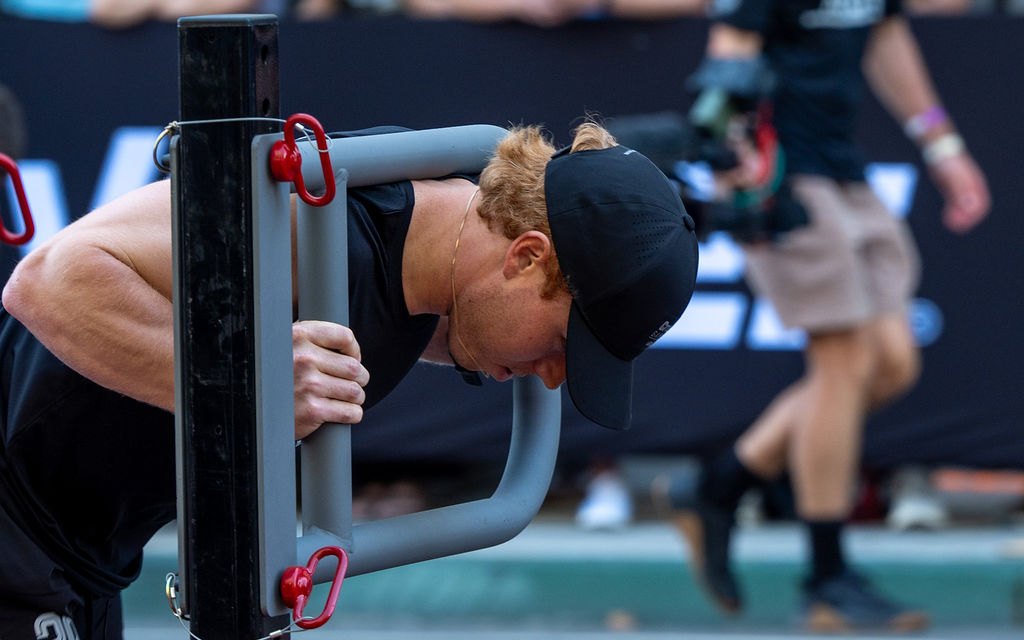
Direct sun with dead air is the worst combination there is. Ryne put it this way: "I would rather be inside in a ninety-two degree gym with fans on me than outside in seventy-five degrees in sun and still air." A simulated sled push indoors with fans and shade does not prepare anyone for the same push outside, followed by ten minutes standing in the sun, followed by another one.
Where heat belongs in the week
If you are using heat as a training tool, it goes on the low intensity work.
Your hard sessions should be protected in a climate controlled environment so the athlete can maximize time at target intensity. "Fatigue is not the goal. Time at velocity is the goal."
Heat produces a fatigue that looks nothing like normal training fatigue. It is whole body and central rather than the tired legs you get from a pile of thrusters, it affects neurotransmitters and testosterone in men, and no cold tub undoes it. Sometimes the athlete lives somewhere hot and there is no choice, which is what Toby was dealing with. Sport demands carry risk, and that is a tradeoff to make on purpose.
The week Ryne actually ran
Monday: Long run, 75 to 80min, started at 9:00 instead of 7:30
  (78 degrees at the start, 83 to 84 by the finish)
Tuesday: Easy run, early morning, before a night baseball game
Wednesday: Rest
Thursday: LT1 session, pushed later into the day
Friday: 45min easy run in roughly 90 degrees, as slow as needed
Saturday: VO2max track work, first thing in the morning
No sessions were added. Existing sessions moved into worse conditions, and the one session where pace had to be protected stayed in the cool part of the day. He credits the Friday afternoon run most for changing how his body perceives heat. When a cool front finally pushed through, his heart rate held in zone 2 while running seven seconds per kilometer faster than before.
He was also clear that this is a stimulus that needs a plan: "playing this game with heat, it can be very, very dangerous." Stacking sauna work on top of summer sessions that already cost several pounds of sweat is not the move. Bring the sauna in when the weather stops supplying the heat for you.
Sweat loss, and why it is a bigger deal for big athletes
Ryne loses three to four pounds on a summer run. I lost five on an hour run the morning we recorded. On a thirteen mile ruck during a heat advisory, drinking constantly the whole way, I lost twelve and a half pounds.
Losing sweat means losing blood volume, and losing blood volume reduces the ability to offload heat. Larger athletes have to shed more heat and lose more fluid doing it. That is why acclimation is not optional for bigger CrossFit and HYROX athletes.
If you have never taken pre and post session body weights on an athlete, do it once this month.
Cognition under fatigue
The episode opened on caffeine and paraxanthine, the metabolite caffeine converts to. It gives you the wakefulness without the jitters or the afternoon crash, and the research that caught my attention had trained runners doing a 10K and then a cognitive test.
Ryne answered the way a runner would: "As an athlete, I don't care whether I can answer what three plus three is after this time trial. What I care about is whether I went faster."
The performance question has its own answer, from a separate trial. Fourteen rowers ran 2000m time trials on the same four conditions at 200mg each. The combined dose of caffeine and paraxanthine produced the fastest times and the highest mean power. Neither one alone clearly beat placebo. Paraxanthine alone did come out ahead on subjective sleep quality, which is the difference that matters if you train at night.
So the ergogenic effect belongs to the combination, and the cognitive effect is the part specific to paraxanthine. That second part is what Ryne pushed on.
For a runner, he has a point. For a CrossFit athlete, the decisions keep coming. I get punch drunk in the middle of a metcon, and I have miscounted badly because of it. Walking back to a barbell at a competition I added eight and three to get twelve, on a workout that called for twelve deadlifts. If a little more cognitive function under fatigue means better rep breaks and better calls on when to push, that is worth something.
Sleep is the recovery modality
Ryne sleeps nine hours. I sleep just under seven and wake at 4:45 without an alarm, and have since I was a kid. We pulled up last night's numbers on the pod and our deep and REM were nearly identical. Sleep need sits on a bell curve and we are on opposite ends of it.
The routines are where the overlap shows. His: a long dog walk after dinner with a low stakes podcast, a cool down, a shower, phone away, reading, lights out by 10:30. Blackout done seriously, a fan, nature white noise, 68 degrees, blue light filtering glasses once the contacts are out, and ten to fifteen minutes of passive stretching where every position gets a ten count inhale and exhale. Mine: 64 degrees, a water cooled mattress topper set to 54, a shower as the signal that the day is over, and every overhead light upstairs switched to red after 8:00.
Neither of those is a mobility routine. "It has nothing to do with the actual mobility. I do full inhale, full exhale on a ten count for every position." It is down regulation, and the breathing is doing the work. The Brettzel 2.0 is in both our routines, and it is the best position I have found for getting real rib cage expansion.
Audit before you buy anything
Ryne gave the bird's eye version and I agree with all of it. If you have never had your nutrition assessed, that comes first, then sleep, then everything else.
Over twenty years and north of two hundred athletes, the pattern does not change. I ask about nutrition, the athlete says it is dialed in, and two questions later we find out they are running two hour sessions fasted with nothing but electrolytes. People certain they have it handled routinely score 50 percent on an honest audit.
Haley built her free assessment for that exact reason, because she kept running into athletes who told her they had it handled. It takes about five minutes and it hands you your gaps. Take it here before you read the rest of this.
Same with sleep. An athlete tells me eight hours, then the wearable data lands in Coach RX and says six forty-five.
Andre is the counterexample. He came to me with protocols built by a sport nutritionist, down to fructose and glucose ratios, protein relative to carbohydrate and fat, what he ate before bed, and how his fluid intake changed with the season and the quality of the session. Ryne's reaction when I showed him was that this is the level of detail you only see when someone has it done for them. Andre went and got it done, and then he did the hard part, which was following it. Look at the results he had.
Plenty of the popular modalities have evidence behind them and I use several. They are worth adding once sleep, nutrition, and a down regulation routine are already there. As Ryne put it: "if you are going to sit in the NormaTec boots for an hour before you go to bed, just get in bed and go to sleep."
Referenced in this episode
- Paraxanthine versus caffeine after a 10K. Yoo C, Xing D, Gonzalez DE, et al. Journal of the International Society of Sports Nutrition, 2024. Twelve trained runners, 200mg doses, double blind crossover. Read it on PubMed
- Paraxanthine, caffeine and 2000m rowing performance. Bingol Diedhiou A, Yildirim UC, Ozdenk S, et al. Journal of the International Society of Sports Nutrition, 2026. Fourteen rowers, four conditions at 200mg. The combination was fastest; neither alone clearly beat placebo. Read it on PubMed
- Post-exercise hot water immersion and performance in hypoxia. Rodrigues P, Simpson LL, Lawley JS, et al. Experimental Physiology. Six weeks of chest deep immersion at 42 degrees Celsius after training, five times per week, 40 to 50 minutes. We were guessing at the numbers on air and got the time and the temperature wrong. Read the study
- Brettzel 2.0, in both our routines. Demonstration from Functional Movement Systems
- Haley's free sport nutrition assessment. Five minutes, and it shows you the gaps. Take it here
- Why We Sleep, Matthew Walker. The reference behind individual sleep need sitting on a bell curve.
Have a question about any of this, or a topic you want us to cover? The conversation keeps going inside Ruth Performance Collective, and I am in there every day.
- Kyle