The Recovery Hierarchy

This month inside the Ruth Performance Collective, we're moving into fatigue: how much is necessary, and how to monitor and manage it. It's also the time of year when athletes start catching colds, which makes it a good time to talk about recovery.
A coach on one of my office hours calls asked about an athlete who had been dragging for over a month. He had a very demanding job and trained in the evening after work. His training log was full of comments about feeling exhausted and weak, he'd been sick a lot, and the only sessions he enjoyed were easy zone 1 and zone 2 days. She had already given him deload weeks, and the comments kept coming.
There are so many possible reasons an athlete feels like this, and most of them have nothing to do with recovery tools. I worked through them from the bottom of the hierarchy up: the balance of his training, whether he was fueled, his sleep, the stress he carried in from the rest of his life, and only then the recovery tools like the sauna, cold plunge or massage.
All stress is stress
As a coach you have to think about problems like these from the perspective of allostatic load. Essentially: all stress is stress. There aren’t isolated stress buckets that compartmentalize training stress from work or home-life stress. An athlete like this has too many stress inputs, and the easiest one for you to control is the one in the gym. So that's where we started.
It's really easy for people in CrossFit to constantly want to do more, because there are so many things you have to be good at. The reality is a lot of times athletes can do more, but it doesn't mean they're adapting positively to it. With this specific athlete, his training wasn’t too much on paper, and it wouldn't be too much for someone whose life is different than his, but for him it was.
1. Balance the training
One of the first things I had the coach look at with this athlete was heart rate variability. I asked her to pull his Apple Watch or Garmin metrics and look at the trend over that time. If heart rate variability is consistently decreasing and resting heart rate is gradually (or rapidly) increasing, it's a really good sign an athlete is overreaching, but it might not be because there's too much training. We have to look at the intensity of training and how it’s distributed across the week. The big thing I try to pull back and ask is: are we doing too much sympathetic work (strength training, metcons and intensity from energy system work) and not balancing it with parasympathetic drivers?
This is the classic hard-charging competitive CrossFitter: the 2 or 3 AM wakeups that happen from elevated cortisol, decreased performance, getting sick a lot, overuse injuries, and an elevated morning heart rate. He was already checking some of those boxes. The things he was liking in training (the lower intensity cardio) are exactly what an athlete in this situation needs to pull themselves out of that state and start to swing it back.
The last time I saw this in one of my athletes, we simply added a mandatory 20-minute nasal breathing zone-2 bike-erg after every session, then finished with 5min of box breathing. Within just a few days his training readiness started to come up, and his training started to feel better over the next week. Balancing the sympathetic inputs with parasympathetic work was all it took.
2. Fuel the work
If the weekly intensity distribution and heart rate data looked normal, the next thing to check was food. He worked all day and then came in trying to hit hard training sessions. It was likely he'd been chronically underfueled and in a small caloric deficit from not really monitoring his food. Haley (my wife) works with a lot of competitive CrossFitters and HYROX athletes, and typically the lowest-hanging fruit she addresses is making sure they're fueled for their sessions. What was he eating between work and his session? How simple would it be for him to have two applesauce packets for about 25g of carbs before the session, and 15 minutes in feel better rather than flat?
Being in a big caloric deficit all day is one of those stresses. Blood sugar has spikes and valleys throughout the day, and every time you get a valley, you get a cortisol spike.
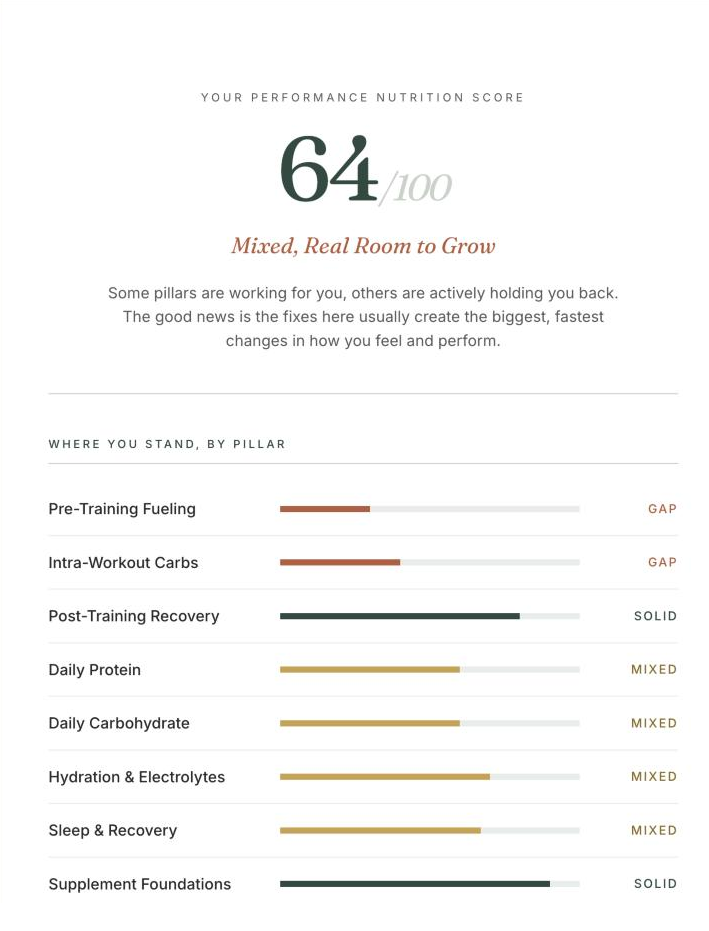
This is why Haley built a Performance Nutrition Assessment that shows athletes where the gaps in their nutrition are and how they might be affecting how they feel in training. It's 18 questions and takes about 5 minutes. At the end, athletes get a Performance Nutrition Score out of 100, a rating for each of eight pillars (from pre-training fueling to sleep and supplements), and their three biggest gaps. Here's what a sample result looks like:
3. Protect sleep
For an athlete who kept getting sick, sleep is the next layer. If you look at the research on colds and respiratory infections, the absolute best thing you can do is sleep. That's when your immune function is at its best. My general recommendation is that, if you feel like you’re getting sick, skip training and go take a nap. One missed session to allow your body to have the resources needed to fight off an infection is a lot better than 3-5 missed because you decided to train through it. You don't want heavy breathing during a respiratory infection, because it increases airway inflammation and makes it easier for the virus to take hold.
Also: don't stress about it! One of the biggest issues my clients face with sleep is lying awake stressing about being in bed too late to get “enough” sleep. I often have to remind my athletes that we only control inputs not outputs. We control what we do before bed (sleep hygiene), we control what time we’re in bed, but we don’t control how well or how long we sleep. Set up your environment to get good sleep, and then don’t stress over it!
4. Manage the stress you can't program around
If those all checked out, the next step was integrating some stress management techniques for him. There's a lot of sport psychology research showing that cognitive fatigue carries into training and performance. Imagine taking a three-hour standardized test where you get paid based on your score, and as soon as you're done you have to go do Jackie. You're not going to do very well, and that's basically what his evenings looked like.
For him, I suggested putting breath work into the warm-up on the bike. While riding at warm-up paces, count your breathing: Inhale is one, exhale is two, and if you get distracted, you start over. Get as high as you can in 10 minutes on the bike, and breathe on a cadence that you extend as you go (3 and 3, then 4 and 4, then 5 and 5). A longer exhale activates the parasympathetic system, so it helps bring everything back to center after a stressful workday. That's also why every conditioning-based workout I write ends with box breathing. Relaxing is a skill just as much as a ring muscle-up is. And if none of that made a difference, the next option was moving his training to the morning, before work if his schedule would allow it.
5. Then the recovery tools
Only then would we reach for recovery tools, and for an athlete like him they needed to be gentle on the body, because you don't want things that are going to stimulate sympathetic drive. Good options for an over-stressed athlete include: meditation, light flushing massage, hot tub, deep water floating, a light swim, or a nap in the middle of the day.
Keep them in perspective, though. A recent network meta-analysis in endurance athletes found that no physical recovery method beat passive rest on any outcome. I posted about this on my IG account recently. My pushback was that some people won't rest unless they have something scheduled to protect their time. That's the best case for a recovery tool: it protects the rest. It can't make up for training that doesn't fit an athlete's life, an empty tank, short sleep or a stressful workday, so start at the bottom.
Pull up the athlete on your roster who's been dragging this month and work up the hierarchy:
- What has their heart rate variability and resting heart rate done over the last few months?
- Are they fueled before they train?
- Are they sleeping, and are they stressing about it?
- What stress are they carrying into the gym, and is there a breathing practice built into their training?
- Are you reaching for a recovery tool before you've answered the first four?
- Kyle