Why Can't Athletes Sleep Before a Competition?
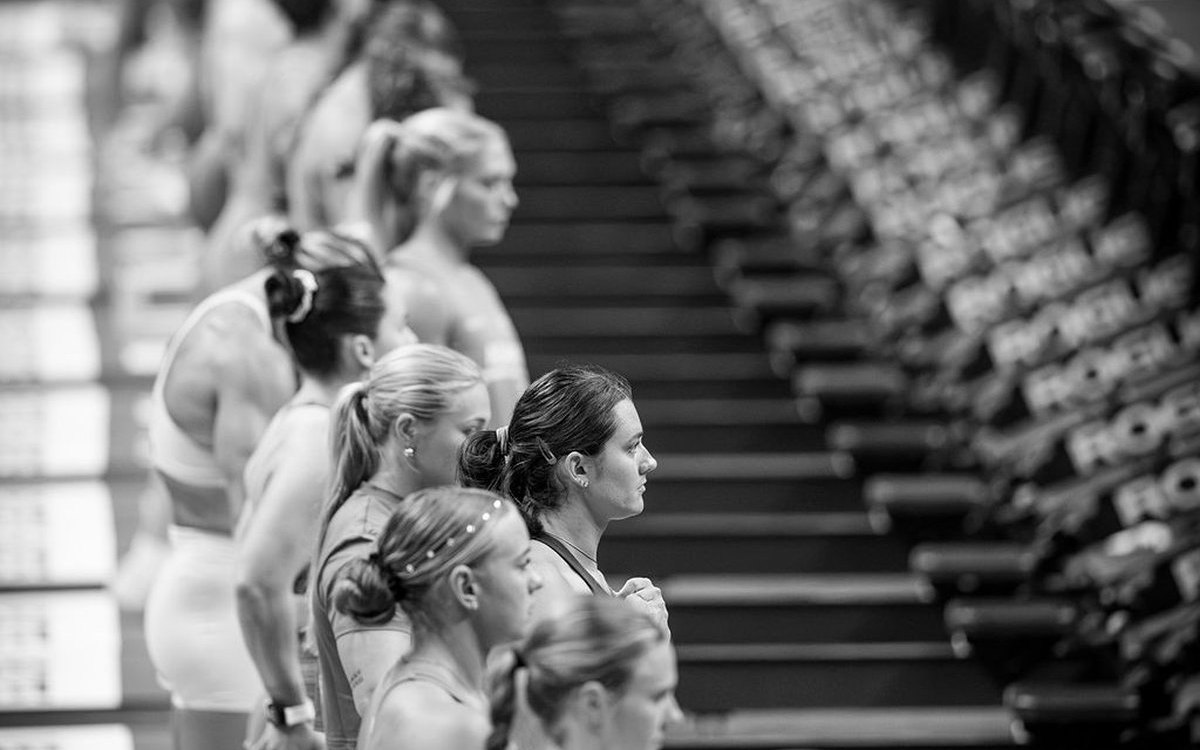
"Relaxing is a skill just as much as a ring muscle-up is. And if you want to be good at it, you have to practice it on a consistent basis."
It is competition season, and Ryne Sullivan and I spent episode 9 on the mental side of competing: why sleep falls apart before a comp, what to do with your head when it does, and how to practice calming down before you need it.
The 2 AM cycle
The day before we recorded, my client office hours got into the sleep disturbance that usually starts about three days out from a competition. The more you care about the event, the earlier it starts. You lie down calm, with everything taken care of, and then event three pops into your head. You get the butterflies and the adrenaline dump, and your brain runs the event over and over for an hour, sometimes three.
Most athletes think they are the only one who does this, and almost every athlete does. In a survey of 283 elite Australian athletes, 64% reported worse sleep before an important competition at least once, most of them had trouble falling asleep, and the top reason was thinking about the competition. On a wearable you can watch it happen: eight hours, then seven, six, five, and four the night before the last day.
Mine shows up at 2 or 3 AM. I fall asleep fine, wake up to go to the bathroom, lie back down calm, and then a thought about the next day's event shows up and the cycle starts. Ryne usually only loses the night before the first day, and he sleeps much better when Marissa travels with him. I think a big part of that is having someone who can remind you that you already have a plan.
Move from non-functional to functional thinking
This is what I pushed everyone on that office hours call toward. Non-functional thinking spends your mental energy on what you cannot control: who is in your heat, how good they are, which events suit them, and how much you dislike the event times.
"Put your worry and your mental energy into things you can control. Review your strategy. Do an actual visual walkthrough. Do a mental rehearsal of the event."
A lot of that anxiety goes away when the plan exists before you go to bed. Review it once, and if you wake up at 2 AM, review the plan again instead of the leaderboard.
Timeline: when you leave, when you need to be at the venue
Warm-up: each piece, in order
Event strategy: where you break, your pace, how long each piece should take
Fueling plan for the day
What you do after each event
Bag packed and checked off (a physical checklist or one on your phone)
Review it once before bed. If you wake up, review it again.
Ryne likes a physical checklist, because crossing things off shows you everything is handled. Then he gets out of fight or flight by sitting in bed breathing slowly, counting to 10 with nothing in his mind except the number he is on.
Breath counting and non-sleep deep rest
That is one of my favorite types of meditation, and it comes from Zen practice. Inhale is one, exhale is two, and you count up to 10. If a thought shows up, you start over at one. Once 10 gets easy, make each full breath one count so you go longer between thoughts.
Inhale = 1, exhale = 2, continue to 10
Any thought: start over at 1
Once 10 is easy: one count per full breath (inhale and exhale)
Use it in bed, before an event, or between events
The other tool I lean on before sleep on a competition day is yoga nidra, which Andrew Huberman popularized as non-sleep deep rest (NSDR). I have used pre-recorded yoga nidra audio for four or five years now. Search it on your phone, put your headphones on, and lie down. Nothing else I have tried puts me in a calmer state before bed.
The stress you carry all day
Ryne pointed out that the problem starts long before competition week. Athletes go to a stressful job, scroll their phone all day, and then go to the gym, which adds stress instead of relieving it. Then they get home to everything that needs doing around the house.
"They've spent from 6 a.m. until 8 p.m. in this heightened state of stress, never giving themselves a chance to back off and relax. And then you're just gonna try to unwind that at 9 p.m. and just turn the lights off and go to bed, doesn't really work very well."
We both put the phone in another room for deep work, because the pull to check it is real. Athletes feel the same pull on game day. In one study, 16 participants rode at 80% of peak power for 640 seconds after a 90-minute mentally demanding task and 754 seconds after watching a documentary. Another found that 30 minutes of social media on a smartphone reduced back squat volume-load compared with a documentary. Neither study found a physiological change that explained the drop.
Practice it before you need it
Most people do not have good strategies for resting, and the competition floor is a bad place to look for one. That is why every conditioning-based workout I write ends with a box breathing session. Whether they do it is a different discussion, but it is there. After Wodapalooza SoCal, a few of my athletes wrote in their debriefs that they struggled to turn it off between events.
"This is your opportunity. You every day have this practice window of box breathing built into your session. Take advantage of it. This is how you learn to relax when you're in a heightened state."
Bring the focus into the warm-up
Cedric was one of the first athletes willing to spend time on meditation to manage his anxiety on the competition floor. Count the places your attention goes during a workout: the athletes on either side of you, your judge, their judge's count, maybe the music. Until the end, when you need to know where the field is, the only things that matter are the rep in front of you and your count.
Most athletes do not have 10 extra minutes a day to lie down and breathe, but they do spend 10 minutes on a bike warming up, so I put breath counting there. It became a mental reset between the day and the session. I learned the running version from Brent Fikowski.
10:00 bike: count breaths (inhale 1, exhale 2...)
  Goal: reach 10 as many times as possible
Running version: count steps per breath
  3 to 4 steps per inhale, 3 to 4 steps per exhale, depending on pace
Ryne's version: row or Echo slightly faster than true warm-up pace
  while nasal breathing only, and relax through the rising CO2
Warm-up only. Never in the metcon.
Ryne's version is a small dose of the moment in a metcon when you have to decide whether to keep going. Restricting the breath raises CO2, which is what you feel in that moment, and you practice staying relaxed through it.
CO2 tolerance and panic
That CO2-driven feeling in a metcon is close to the anxiety athletes feel in other places throughout the day. In Breath, James Nestor describes carbon dioxide therapy: patients breathe a gas mix high in CO2, which can trigger a panic attack, and repeated sessions were reported to reduce anxiety and panic symptoms.
Swimmers show the same thing. Of the 300 or 400 CrossFit athletes I have coached in the pool, most panic in the water at some point. A minute and a half or two minutes into a 300 time trial, it feels like they are tunneling out. The most common reason is that they hold their breath with their face in the water, so CO2 creeps up stroke after stroke until they hit their tolerance, while their oxygen saturation is probably fine. My nine-year-old, who is about to start swim team, did exactly that, and low bubbles underwater fixed it.
Ryne would expose every CrossFitter to intensive and extensive VO2 work to build tolerance for very high breathing rates. I would add one step: as soon as the interval ends, get the athlete back to nose breathing. It keeps CO2 elevated longer and brings heart rate down quickly in the recovery period. I have also tested this with the Isocapnic Breathe Way Better, which recaptures CO2. When Brent, Luke Way (who invented it), Dr. Andrew Sellars and I talked about it, one of the leading theories was that higher CO2 dilates the blood vessels and keeps blood flowing to the working tissue between intervals.
"It feels terrible to do the Breathe Way Better between intervals, but the next interval feels better, which is a strange thing to think about."
Ryne put it this way.
"If you're chasing performance, ultimately you do the thing that creates performance, not the thing that creates subjective good feeling."
A life outside the sport
Ryne sees a lot of athletes whose job is coaching CrossFit, whose hobby is training for CrossFit, and whose downtime is watching CrossFit videos. His fix is a hobby that takes enough attention that you cannot do it passively, like knitting, an instrument, or woodworking.
"Having something where you craft or create some sort of art, whether it's playing an instrument or woodworking or anything along those lines, creates this deep engagement with that task, but it also creates a deep disengagement with spiraling thoughts because you have to be engaged with that task."
Elite athletes need this too. When the sport becomes all-consuming, training starts to feel like a chore. I was that athlete as a swimmer and again in CrossFit, and the burnout happened anyway.
Ryne added that when the sport is all you have, failure becomes an attack on who you are. I would not call the answer "not caring." For me it was giving myself permission to fail.
"If your entire existence is riding on the outcome of an event, that level of pressure prevents you from taking the risks that could allow you to actually win an event or encourage you to take massive risks to try to win an event, which will almost always backfire on you."
Fikowski once asked me over lunch how often the big all-or-nothing risk pays off, and we both laughed, because it almost never does. That pressure is what sends athletes out too hot and off their pacing.
The same mindset shows up in skill work. Ryne has an athlete who knows they take too many steps on handstand pirouettes but will not try fewer in case they fail. The best athletes he has watched train do not care how many no reps they get in practice.
"They actually have defined failure as having the same technical efficiency at the end of the session that they had at the beginning."
Stop stressing about your recovery
Stress about sleep makes sleep worse.
"Yes, I want to be in bed by 10 p.m., but if you don't get in bed until 10:20, don't start thinking about the fact that you're getting 20 minutes less sleep because that's going to turn into an hour and 20 minutes less sleep."
Haley and I do not have important conversations in bed, even about weekend plans, because they keep us up thinking about everything we have to do tomorrow. We have those in the morning. One of my athletes recently switched bedrooms and slept much better, which reminded me of the advice to keep the bedroom for sleep and do your work somewhere else.
Ryne also brought up a recent review of recovery modalities in endurance athletes, which found that no ice bath, compression, or other physical recovery method beat passive rest on any outcome. Those tools may have other benefits, and placebo works if you expect it to. My pushback is that some people will not rest unless something protects the time, and I am one of them. The sauna works for me because I cannot take my phone in there.
Coaches, read The Expectation Effect by David Robson. Athletes, do not, because I do not want you to know the tricks. If you are both, read it, because you will be a coach forever and only an athlete for a while.
You are not alone in this
"I hope that any athlete listening will recognize that their experiences are very similar to most athletes' experiences in competition. You're not experiencing these things alone, but there are methods for dealing with it."
A year with a mental performance coach gave me new tools for my own competing and for my athletes. Your competitors at the venue are not the people to share any of this with, though. Ryne once coached an athlete who brought three shirts to a good training day and changed between sets, so every heavy snatch on Instagram looked like it came from a different day. Nobody snatches their best every time they walk into the gym.
When I was younger I played the mind games hard. Now I am friendly with almost everyone I compete against at the Masters level, and I am not giving any of them my mental bandwidth.
"From a competitive perspective, they own no rent free space in my mind."
Referenced in this episode
- Sleep before important competitions. A survey of 283 elite Australian athletes: 64% reported worse sleep before an important competition at least once, 82% of those described trouble falling asleep, and thoughts about the competition were the most common cause (83.5%). Juliff LE, Halson SL, Peiffer JJ. Journal of Science and Medicine in Sport, 2015;18(1):13-18. Abstract
- Mental fatigue and endurance. 16 participants cycled at 80% of peak power to exhaustion for 640 seconds after a 90-minute cognitive task versus 754 seconds after a documentary, with higher perceived effort and no change in heart rate or lactate. Marcora SM, Staiano W, Manning V. Journal of Applied Physiology, 2009;106(3):857-864. Full text
- Smartphone use before training. 30 minutes of social media use reduced back squat volume-load in 16 trained adults compared with watching a documentary. Gantois P, Lima-Júnior D, Fortes LS, Batista GR, Nakamura FY, Fonseca FS. Perceptual and Motor Skills, 2021;128(4):1640-1659. Abstract
- Breath counting. A study that uses counting breaths in sets of nine as a measure of mindfulness, based on the Zen practice. Levinson DB, Stoll EL, Kindy SD, Merry HL, Davidson RJ. Frontiers in Psychology, 2014;5:1202. Full text
- Non-sleep deep rest (NSDR). Huberman Lab on NSDR
- Breath: The New Science of a Lost Art by James Nestor (Riverhead, 2020). The carbon dioxide therapy section covers CO2 inhalation for anxiety and panic.
- Isocapnic Breathe Way Better. The respiratory trainer Brent, Luke Way, Dr. Andrew Sellars and I discussed on The Fitness Movement, "Respiratory Roundtable" (Ep. 191, June 2025). Episode
- Isocapnic breathing after intense work. The closest study I found: 39 elite short track speed skaters did 3 minutes of voluntary isocapnic hyperpnoea after a Wingate test, which lowered perceived fatigue more than passive rest, with no difference in lactate. It did not test a second interval. "Influence of voluntary isocapnic hyperpnoea on recovery after high-intensity exercise in elite short-track speedskaters." BMC Sports Science, Medicine and Rehabilitation, 2024. Full text
- Recovery modalities versus passive rest. A network meta-analysis of 16 randomized trials (273 competitive and elite endurance athletes) found that no physical recovery modality outperformed passive recovery on any outcome, with small samples throughout. Jin Y, Pan D, Li M, Zhu D, Wen J. Frontiers in Sports and Active Living, 2026;8:1876924. Full text
- Keeping the bedroom for sleep. This is stimulus control, one of the behavioral treatments for insomnia. Edinger JD, et al. "Behavioral and psychological treatments for chronic insomnia disorder in adults: an American Academy of Sleep Medicine clinical practice guideline." Journal of Clinical Sleep Medicine, 2021;17(2):255-262. Abstract
- The Expectation Effect: How Your Mindset Can Change Your World by David Robson (2022). Author page
- Last week's episode. What Does Sport-Specific Training Look Like in CrossFit?
Inside Ruth Performance Collective we have one more week on rethinking strength, including how I use bodyweight and strength-to-bodyweight ratios to make training decisions. Starting the second full week of October, we move into fatigue: how much is necessary, and how to monitor and manage it.
- Kyle