What Does Sport-Specific Training Look Like in CrossFit?
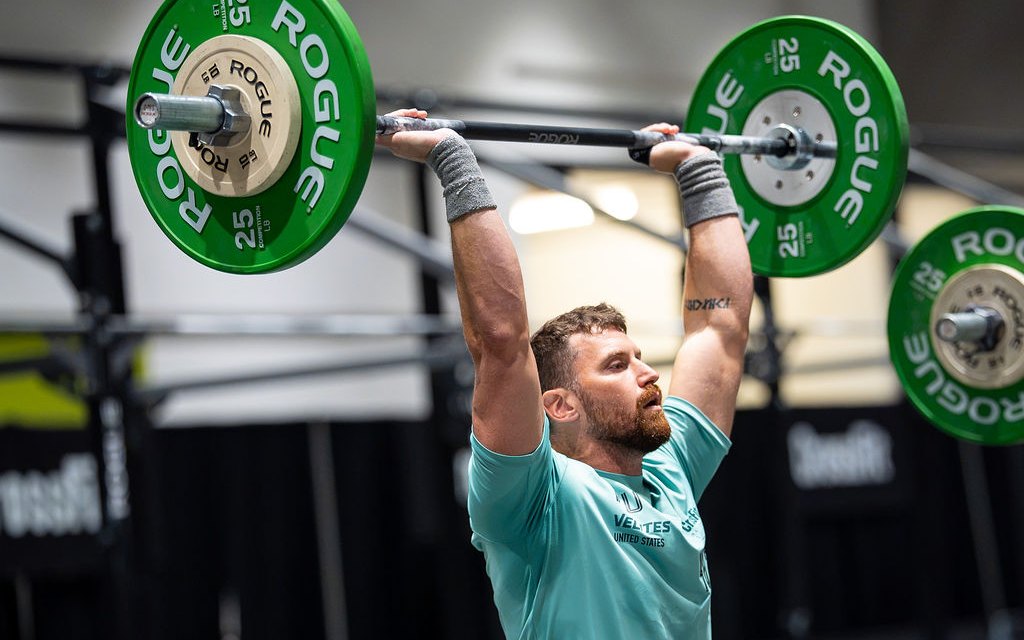
"What is sport specific for you as an athlete is dependent on the level that you are trying to achieve."
That line came about twenty minutes into episode 8, and it answers the question Ryne Sullivan and I set out to talk about. For years coaches, me included, have said training should get more sport specific as the season gets closer. Ryne defined specificity as training that mimics what you will be asked to do in competition. I added a condition: you need a defined outcome first. There is no such thing as sport-specific GPP, because GPP has no outcome. CrossFit has the Open, quarterfinals, semifinals, and the Games, and we have years of data on what each stage tends to look like.
Define it one movement at a time
Specificity has layers: movement speed, set size, total volume, loading, and the energy system. The transitions shape that last one. An online qualifier puts the tape five feet from your equipment, and an in-person semifinal can put 30 to 50 feet between stations. Fast transitions keep the average power of the workout high. An easy jog to the next station changes what the workout trains.
Wall ball is the easiest example, because we have talked about it on this show so many times.
"You know you need to be training wall balls at 1.8 seconds per rep for sets of at least 20 plus for a target functional volume of we'll say at least 150, but it's potentially quite a bit higher than that. There is the definition of sport specificity for wall ball. Now do that for every movement."
Movement speed: 1.8 seconds per rep (the competitive threshold)
Minimum set size: 20 unbroken (prescribed sets usually start at 15 to 20)
Functional volume: at least 150, and it may run as high as 240
Then build the same three numbers for every other movement
Ryne raised the problem with that. You can prepare for all of it and then get Open 23.1, the repeat of 14.4: a 60 calorie row, 50 toes to bar, 40 wall balls, 30 cleans, and 20 muscle-ups. The wall balls barely mattered. I called them a trap, because the athletes who went too big on them blew up on everything after, and even athletes deep into a second round only saw 45 or 50.
So the preparation is a bet. From about 2016 to 2019 a lot of my bets were vibes. Now I lean on past data and trends.
Spend the currency where it buys the most
Ryne sorts movements into buckets and gives each athlete a priority list. One of his athletes has elite wall balls at any load and any target height, but her heavy thrusters fall apart. She still needs tissue tolerance for wall balls, and he spends most of her squat plus press work on heavy thrusters, because that is where the biggest gain is.
Four weeks out from an unknown-workout stage like the Open, I would build the week the same way. The main sport-specific piece is moderate-load thruster cycling, maybe a couplet with muscle-ups if it looks like a quarterfinal workout. Wall ball gets a supporting EMOM, maybe paired with a row. That hedges the bet without stacking a second hard metcon into the day before a snatch session.
The stage changes the bet
Ryne flips that decision for in-person competition. If heavy thrusters would put his athlete in the bottom seven of a 30-person field, four weeks of hammering them might move her from 23rd to 20th. If four weeks on wall balls turns an eighth-place finish into second, he takes the wall balls.
"The points in person are rewarded much more for high finishes and in the open you get punished more for low finishes."
That only works in a small, deep field where the point spread lets a bad event survive. One stage back, an athlete who never invested in weaknesses does not make it out of quarterfinals. I have had this conversation with athletes who compete in person in the off-season, get wrecked by a heavy sandbag, and want to make it a priority.
"We're not even going to make it into an in-person semifinal with where your current level of qualifier fitness is. We have to take care of all of this first before we even worry about sandbags."
Once they qualify consistently, those become off-season priorities. Ryne compared it to the jar story, where the big objects go in first and the sand settles around them. His rough filter is the Open. Outside the top 500, the odds of producing a semifinal performance with any regularity are very low, and for the Games it is closer to the top 200. The biggest exception is Tia-Clair Toomey-Orr, who finished 2,610th in the 2024 Open and then won the 2024 Games.
"The amount of people who want to focus on can I snatch three hundred pounds when they can't do a hundred bar facing burpees in under seven minutes is pretty substantial."
Running shows specificity widening as you move up. For an Open athlete, sport-specific running means shuttles, and quarterfinals are still shuttles. Semifinals add long runs and mixed running, without sprinting. The Games need all of it, and you still have to fill the jar at every stage to get there.
For the athlete doing this for fun
Most of the people we coach do this as a hobby, and they still want to have fun. My version is type two fun: an off-season side quest tied to the long-term goal. Last year it was a 5K and a weightlifting meet. This year it is my five-mile time trial and new PRs in the back squat, deadlift, and bench press. If the leaderboard matters to you, the fun has to tie back to the goal.
"If you need to gain ten blocks forward, it's okay to take a diagonal where you only gain half a block, but you still have to be gaining forward. It can't be backwards."
Set size before speed
My filter starts with whether the athlete can hit the required set sizes and functional volumes for each movement in isolation. The first dominant regional athletes were the ones who could do huge unbroken sets, and movement speed came later. I do not care how fast you cycle burpees if you cannot do all the burpees in the workout.
My own GHD sit-ups are slow, and past about 30 I struggle to stay unbroken. So I build density until I can do 50 unbroken, then chase speed targets: 20 under 40 seconds, 30 under 60. Ask me for 20 under 40 today and I might get one set, then cramp around rep 60 of a workout that asks for 100.
Ryne added that volume first also builds resilience. An athlete with a base can train chest to bar on Monday and ring muscle-ups on Friday. Ryne said if he did chest to bar on a Monday right now, he could not pull again until the next Monday, and you cannot train the rest of the sport around that.
Keep the soreness movements warm
Some movements have to be touched consistently or the first high-volume workout devastates the athlete: chest to bar, GHD sit-ups, wall ball, lunges, and deadlifts. Event 1 at the 2026 Games was a 1,000 meter row followed by five rounds of 25 pull-ups and seven push jerks. I tested it with Alexis and know how sore we both were, and Patrick Vellner told us he thought he had rhabdo for five days. We had been doing chest to bar in metcons, just not 125 pull-ups.
Ryne's point was that chin over the bar pull-ups are denser. The range is shorter, the reps turn over faster, the sets get bigger, and more density means more muscle damage. Faster lengthening contractions cause more damage than slow ones in the research too.
8 to 10 weeks out: build volume on the soreness-prone movements
  (chest to bar, pull-ups, GHD sit-ups, wall ball, lunges, deadlifts)
  and hold it all the way into the competition
Tuesday before the competition: a fairly dense EMOM or AMRAP
  built from the competition movements most likely to make the athlete sore
Athletes push back on that Tuesday session.
"You need this now so that when you do it on Saturday, you're not so sore that it affects everything after that."
With five metcons across three days, the athlete cannot carry midline soreness into a 1RM clean.
Four weeks to a 40-yard sprint
Right before we recorded, I was talking with Sydney Smith about an APEX event: a 40-yard sprint, a medicine ball throw, broad and vertical jumps, a trap bar deadlift AMRAP, a bench press AMRAP, and a mile. Unlike a CrossFit taper, you want no fatigue at all going in. So I asked Ryne how he would prepare a hamstring in four weeks for an athlete who has not been sprinting.
He starts on a 3 to 5 percent hill. The incline slows the athlete and shortens the reach, so the hamstring handles less eccentric force, and hamstrings usually tear during the eccentric. Any steeper and the speed stops carrying over.
Weeks 1 and 2: hill sprints on a 3 to 5% incline, twice a week
Weeks 3 and 4: flying 40s and 60s at about 8 out of 10
  (I was thinking roughly 400 meter race pace)
On the day with the most space before the next sprint session:
  eccentric hamstring work, such as eccentric Nordics
  or single leg hamstring curls on a rower
My instinct was to add aggressive single leg kettlebell swings, because the movement speed is closer to sprinting. Ryne preferred support over more speed-specific loading in a four-week window, and I think he is right. At least Sydney has been doing long and short length hamstring isometrics, so her tendons have been trained. I lean aggressive, and Ryne leans supportive.
Let the competition work be the competition work
Ryne learned this with Holden, a pitcher he coaches. When Ryne kept supportive speed work in during the performance phase, Holden's velocity ticked down. When he stripped it out, the velocity came back. His rule now is to let the competition-specific work be the competition-specific work.
I see the same thing in CrossFit. Support work that looks too much like the real task adds fatigue that masks what the athlete can do. When an athlete is peaking, I keep one small dose to hold sprint capacity (three 10-second Echo bike sprints with three minutes rest, once a week) and let the training do the rest. Athletes tell me they feel like they are getting out of shape, and their CrossFit performance keeps climbing anyway.
Ryne explained it with the fitness-fatigue model. If fitness drops from 96 to 93 while fatigue drops from 100 to 65, performance goes up.
"I think that is a big trap for a lot of athletes, is they think that they need to feel good in order to perform well."
That is why I call what I do performance coaching. Sometimes you will not feel as good as you think you should in training, so that you can feel good on game day.
Accessory work has joint angles too
Accessory work should match the angles of the sport movement, and those angles depend on the athlete. For legless rope climbs, Ryne would pick vertical pulling over horizontal. That fits Alexis, who climbs very vertically. When I watched Hopper at Wodapalooza in March, he climbed with his body almost horizontal, so for him horizontal pulling might transfer better.
Strict pull-ups still earn their place when you train them through the biggest range you have, with full depression at the top and full elevation at the bottom. Ring muscle-ups and legless climbs need that last bit of depression, and stopping when the chin clears the bar skips it. It is the same as training parallel squats and wondering why the strength does not show up in a full-depth squat clean.
Opening the overhead position
Ryne has coached plenty of men who handle a 185-pound barbell overhead lunge and fall apart with two 50-pound dumbbells, because without a bar tying the arms together, each shoulder has to stabilize on its own. Not every fix works. Three days before we recorded, I was filming a lying lateral pullover for this, felt the range opening, and then felt my shoulder pop. Nobody is doing that one. This routine has done more for my athletes' overhead positions than anything else I have tried.
3 rounds:
  Loaded elevated cat PNF stretch
    Hands on a barbell in the rack, dip belt around the mid back
    5 seconds stretch, 5 seconds contract hard against the stretch,
    then drop deeper. 3 cycles.
  Double dumbbell or kettlebell overhead carry
    Build the load each round
Then go straight into the day's overhead work
  (jerks, double dumbbell overhead walking lunges)
Multiple times per week
Stretching on its own does much less than stretching built into a system. You open the range, strengthen it, then stabilize it.
Referenced in this episode
- Open 23.1. A 14 minute AMRAP of a 60 calorie row, 50 toes to bar, 40 wall-ball shots, 30 cleans (135/95 lb), and 20 muscle-ups, a repeat of 14.4. On air we called the cleans power cleans; the standard allowed any clean. WODprep on 23.1
- 2026 CrossFit Games Event 1, "2007 Hopper." A 1,000 meter row, then five rounds of 25 pull-ups and 7 push jerks (135/85 lb). CrossFit Games
- Tia-Clair Toomey-Orr. 2,610th worldwide in the 2024 Open, then champion of the 2024 Games. Games athlete profile
- APEX. Seven events in order: a 40-yard sprint, a medicine ball throw (8/6 lb), a standing broad jump, a vertical jump, a one-minute trap bar deadlift AMRAP (405/275 lb), a bench press AMRAP (225/115 lb), and a mile. On air I had the women's bench at 155; it is 115. APEX rulebook
- The Nordic hamstring exercise. Across 15 studies and 8,459 athletes, injury prevention programs that included Nordics halved the hamstring injury rate. van Dyk N, Behan FP, Whiteley R. British Journal of Sports Medicine, 2019;53:1362-1370. Abstract
- When hamstrings get hurt in a sprint. Modeling puts peak hamstring stretch in the late swing phase, while the muscle is lengthening under load. Chumanov ES, Schache AG, Heiderscheit BC, Thelen DG. British Journal of Sports Medicine, 2012;46:90. Abstract Early stance is still debated as a second danger point. The hill sprint progression is Ryne's reasoning from that mechanism; I did not find a study measuring hamstring load on a 3 to 5 percent incline.
- Eccentric speed and muscle damage. Fast (210 degrees per second) lengthening contractions of the elbow flexors caused more strength loss, range of motion loss, and creatine kinase rise than slow (30 degrees per second) ones. Chapman D, Newton M, Sacco P, Nosaka K. International Journal of Sports Medicine, 2006;27:591-598. Abstract
- Tendon adaptation. A meta-analysis of loading studies in healthy adults found that tendon stiffness responds to high loading intensity, and the type of contraction (isometric, concentric, or eccentric) did not change the result. Isometrics are one reliable way to get there. Bohm S, Mersmann F, Arampatzis A. Sports Medicine - Open, 2015;1:7. Full text
- The fitness-fatigue model. Performance modeled as fitness minus fatigue, each with its own decay rate. Banister EW, Calvert TW, Savage MV, Bach T. "A systems model of training for athletic performance." Australian Journal of Sports Medicine, 1975;7:57-61.
- The jar story. The version Ryne told circulates as a professor filling a jar with golf balls, pebbles, and sand. Stephen Covey popularized the "big rocks" version in First Things First (1994).
- The Performance Coaching Filter. How I decide what earns development time. More Programming Options Don't Produce Better Programs
- Last week's episode. The Olympic lifting decision tree, including the ATHX announcement. Is There a System for Improving the Olympic Lifts in CrossFit?
Have a question about any of this, or a topic you want us to cover? The conversation keeps going inside Ruth Performance Collective, and I am in there every day.
- Kyle